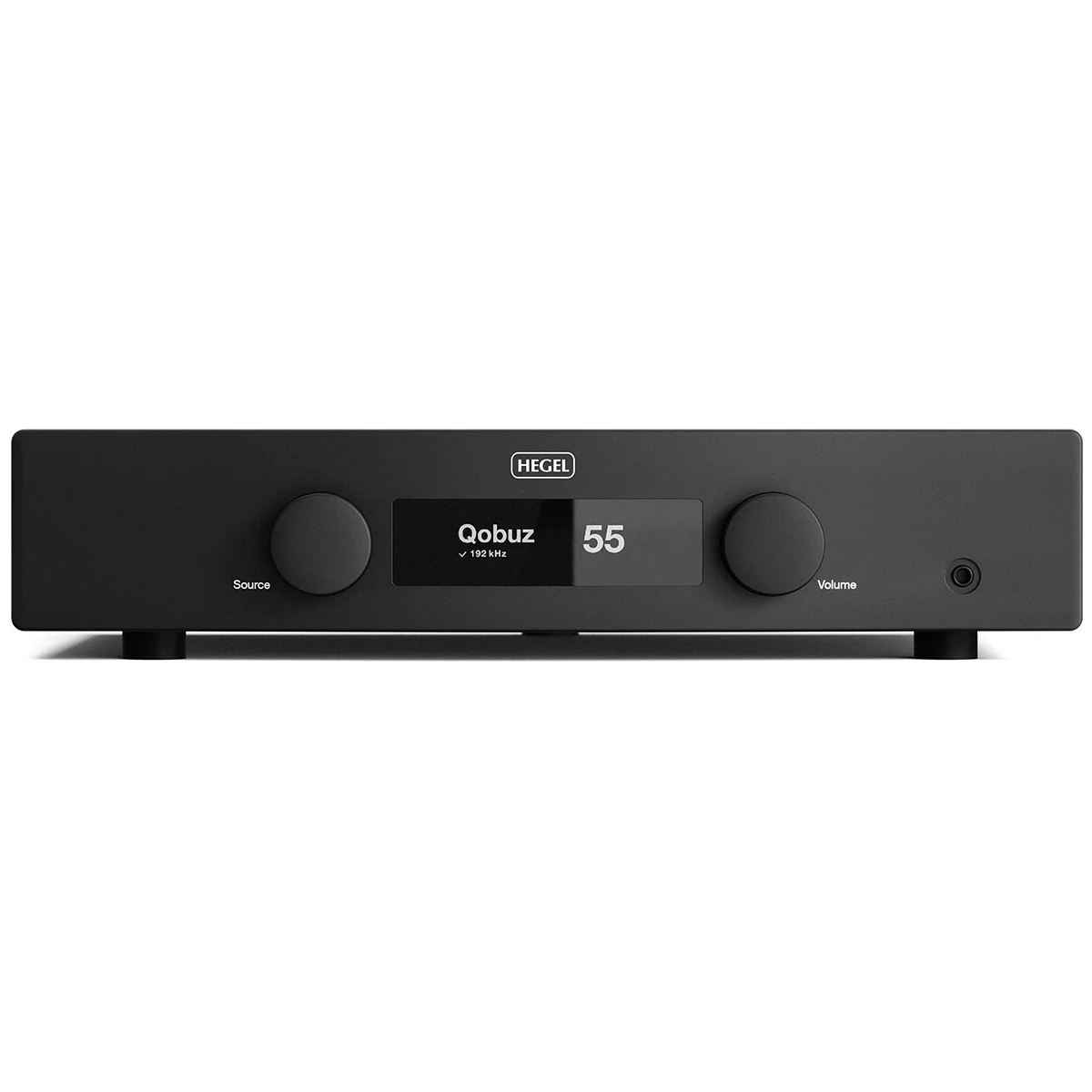
Hegel H150 The Prodigy Streaming Amplifier
There’s a certain kind of hi-fi component that makes you simplify your whole system without feeling like you are settling. That’s the lane Hegel has been living in for years. Clean industrial design, a “get out of the way” sound, and the kind of control over speakers that usually takes a bigger, heavier amplifier to pull off.

The Hegel H150 is the newest streaming integrated amp in that tradition, stepping in where the well loved H120 sat for a lot of listeners. Hegel’s internal nickname for it is “The Prodigy,” and the idea is pretty straightforward: pull as much of the newer Hegel platform and voicing as possible down into a more attainable integrated, without turning it into a complicated lifestyle box. The H150 is still very much a Hegel. Minimal on the outside, serious where it counts on the inside, and aimed at the person who wants one component to be the hub of a real stereo.
If you have been watching Hegel’s recent direction, especially with their higher-end integrated amps, this one makes a lot of sense. You are getting their latest streaming platform, modern “connect” streaming support like Qobuz Connect, and the kind of speaker grip Hegel is known for, all in a compact chassis and a simple day-to-day experience.
Design and Build Quality
Hegel’s design language is basically Scandinavian understatement, and the H150 does not try to change that. The front panel is clean and purposeful. You get two large rotary knobs, one for source selection and one for volume, with a clear OLED display in the middle. No extra buttons, no clutter, no “feature wall” on the front.
The casework feels like it was built to last. The front panel and dials are machined aluminum with a precise, confidence-inspiring feel, and the top cover is steel with ventilation cutouts. On top, the H150 uses a new vent pattern that gives it a slightly more modern look while still staying on-brand.
It is also a genuinely easy amplifier to place. It is full rack width, but it is not overly tall, and it is not comically deep, which matters if your cabinet is more “living room furniture” than “audio shrine.” And it comes in both black and white, which is a small thing that ends up being a big deal when you are trying to make a system look intentional in a shared space. The white version even has subtle hardware details that add a bit of character without turning it flashy.
That OLED display is readable from across the room, and you can dim it or shut it off entirely, which is exactly what most people end up doing in a dedicated listening room anyway.
Connections and Day-to-Day Usability
The H150 is designed to be the center of a modern stereo, so the connectivity mix is practical.
On the streaming side, you are covered for the big ecosystems. It supports Spotify Connect, Tidal Connect, Qobuz Connect, Apple AirPlay, Google Cast, and UPnP. It is also Roon Ready, which matters if you want a whole-home library experience that still feels “audiophile-first.” For radio and spoken-word listening, the H150 integrates internet radio and podcasts through Airable inside the Hegel Control app, and you can browse a huge catalog of stations without needing a separate tuner.
One important note: Hegel is firmly in the “wired Ethernet” camp. There is no built-in Wi-Fi antenna. If you cannot run a cable to your rack, you can still make it work using common networking solutions like adapters or powerline options, but Hegel’s position is clear. They prioritize keeping noise out of the chassis, and they would rather you use a stable wired connection than introduce more radio-frequency junk into the box.
For physical inputs, the H150 gives you a strong spread of digital and analog. Digital inputs include a coaxial input, two optical inputs, and USB for connecting a computer or streamer, plus Ethernet for network playback. One of the optical inputs is optimized for TV use, and that’s a very “Hegel” approach: instead of chasing HDMI features, they focus on making the connection they did include work as well as it can.

There is also a USB port intended for direct playback from a flash drive or an external USB hard drive. That is a newer direction for Hegel, and it is not just a convenience add-on. The idea is simple: plug in local files, browse them in the app, and play them straight from the amp.
On the analog side, you get both single-ended RCA and a true electronically balanced XLR input. If you have a balanced source, Hegel would absolutely rather you use XLR.
And then there’s the part that surprises people at this level: the H150 includes a moving magnet phono stage. If you are building a modern “one box plus speakers” system but still want a turntable in the mix, that phono input changes the whole value equation. It is not a token feature, either. Hegel has talked openly about putting real effort into lowering noise and getting that phono stage to a standard they were happy attaching their name to.
For outputs, you have a variable analog line output that can be used for adding a subwoofer, feeding powered speakers, or using the H150 as a preamp into a separate power amplifier later. That means the H150 can grow with you if you decide to scale up the system over time.
There is also a headphone output, and importantly, the headphone experience is treated like a real mode of listening. The H150 can maintain separate volume memories for speakers and headphones, so you are not constantly readjusting every time you swap.
The “DAC Loop” Feature, and Why It’s Actually Useful
One of the most forward-thinking features on the H150 is something Hegel calls the DAC loop.
In normal systems, if you add an external DAC later, the setup can get messy. You end up routing sources differently, losing convenience, or giving up the internal streaming features you paid for in the first place.
With the H150, you can send digital audio out through the coaxial digital output, into an external DAC, and then route the analog output of that DAC back into the H150 through the balanced input. Once the DAC loop mode is enabled, the amplifier handles the routing intelligently so you keep the H150’s streaming and input switching experience, but you can upgrade the digital conversion stage whenever you want.
It’s one of those features that sounds nerdy until you realize what it means in real life: buy the H150 now, enjoy it as a complete system hub, and if you ever get the itch to explore higher-end DACs later, you do not have to replace the amp to do it.

Features and Technology Under the Hood
At its core, the H150 is a Class A/B integrated amplifier rated at 75 watts per channel into 8 ohms. On paper, that number looks modest compared to some “big spec” amps, but Hegel has never been about headline wattage for marketing points. Their reputation has been built on control, stability, and low distortion under real speaker loads.
The H150 uses Hegel’s SoundEngine 2 technology, which is a big part of why their amplifiers tend to sound clean and composed without becoming sterile. In plain language, SoundEngine is designed to reduce distortion in real time, including the type of distortion that can show up as transistors hand off the signal during the waveform. That is one reason Hegels often come across as smooth but still highly detailed, especially when the music gets dense.
The other headline number that matters here is damping factor, rated above 2,000. Damping factor is not the kind of spec you hang your whole buying decision on, but it does help explain a consistent Hegel trait: bass that feels tight, controlled, and confident, especially on speakers that can get a little loose or boomy with lesser amps.
Hegel also claims stability down to very low impedance loads, even as low as 2 ohms. That does not mean every hard-to-drive speaker suddenly becomes easy, because power supply strength still matters and 75 watts is still 75 watts, but it does speak to the amplifier’s composure and its ability to remain stable when the speaker load gets challenging.
Inside, the power supply approach stays consistent with Hegel’s priorities. They are focused on keeping noise low and current delivery fast. That includes a substantial toroidal transformer for the main supply, additional attention to local power regulation, and an overall “keep it analog and quiet” mindset. Hegel has also made a point that they avoid internal switching power supplies in this category because of the noise they can introduce.
On the digital side, the H150 includes a DAC that is AKM-based, and the overall digital section is designed to match the character of Hegel’s current-generation products. The supported resolutions cover what most people need in a real system, including up to 24-bit/192kHz PCM over USB input, and high-resolution support across the other digital inputs as well.
Performance
The best way to describe the H150 is that it sounds like a modern Hegel should. It does not put a heavy fingerprint on the music. It does not try to warm everything up to sound “lush,” and it does not sharpen the top end to fake detail. Instead, it leans into clarity, speed, and control, with a background that stays quiet enough that small details come through naturally.
Bass is the first thing most people notice, especially if they are coming from an integrated amp that gets a little soft down low. The H150 has that classic Hegel grip. Kick drums have shape instead of just thump, bass guitar lines are easier to follow, and low-frequency texture stays intact instead of turning into a blob when the mix gets busy. It also avoids the “hi-fi demo trick” of artificially inflated bass that impresses in a showroom but gets tiring at home. The weight is there when it is on the recording, and the control stays consistent.
The midrange is where Hegel tends to win long-term, because it is neutral in a way that makes voices feel honest. Dialogue-heavy content, singer-songwriter recordings, and anything where vocal tone matters tends to sound clean and unforced. You do not feel like the amp is editorializing.
Up top, the H150 is refined rather than showy. You still get air and shimmer when it’s in the material, but it does not push treble energy just to create the impression of detail. That approach makes it easy to listen for hours, which is really the point.
One other thing that comes through in good systems is timing. The H150 keeps transients tidy and rhythmically convincing. That does not sound exciting as a phrase, but you feel it. The system locks in. Stereo imaging becomes more stable. Busy tracks stay separated instead of turning into a wash.
Noise floor is also part of the story. When an amplifier gets quieter, the whole presentation tends to feel more resolved, not because it is “brighter,” but because the small stuff is no longer masked. The H150 has that kind of low-level cleanliness, and it shows up in spatial cues, decay trails, and those little room reflections that make recordings feel real.
Pairing and System Building
The H150 feels especially at home with high-quality standmount speakers and many reasonably efficient floorstanders. It has the control to make compact speakers sound bigger and more confident than you expect, and it has the refinement to avoid turning revealing speakers into a fatigue machine.
At the same time, it’s smart to be honest about system matching. Some speakers are genuinely brutal loads, and while the H150 is stable and well controlled, there are still situations where more power and current delivery will matter. If you are running very inefficient speakers, huge rooms, or speakers with punishing impedance swings, Hegel’s higher-powered integrated models may be the better fit.
The good news is that the H150 does not box you in. Between the variable line output for subwoofer integration and the ability to use it as a preamp, you can build a system that scales. Add a sub later. Add an external power amp later. Add an external DAC later through the DAC loop. The H150 can stay at the center while the rest of the system evolves.
What the H150 Does Not Try to Be
This is worth calling out, because it helps set expectations.
The H150 is not chasing the feature checklist some competitors use to win the “spec war.” You are not getting a big color touchscreen. You are not getting album art on the front panel. You are not getting HDMI ARC. You are not getting Bluetooth convenience. And you are not getting built-in Wi-Fi antennas.
For some people, those omissions are dealbreakers. For the audience Hegel is targeting, it’s the opposite. The H150 is built around the idea that every extra subsystem is another opportunity to inject noise or compromise the signal path. So Hegel sticks to what they consider “essential conveniences” and focuses the budget and engineering where it impacts sound quality and stability.
One practical nitpick: the front display is functional, but it is still very minimal by modern standards. Most of the “rich” browsing experience lives in the app. If you want a front panel that doubles as a mini tablet, that is not this product.

Final Thoughts
The Hegel H150 is what happens when a company with a clear sound philosophy updates the platform around it without losing the plot. It is compact, simple to operate, and genuinely flexible as a system hub. The streaming support is modern in the ways that matter, especially with Qobuz Connect onboard. The phono stage makes it much more “complete” for the person who still spins vinyl. And the DAC loop is the kind of upgrade-friendly feature we wish more integrated amps would adopt.
But the real reason you buy it is the same reason you buy any Hegel: the amplifier section itself. The H150 has that neutral, controlled, low-distortion presentation that makes good speakers sound more like themselves, just with better grip, cleaner dynamics, and a quieter background.
If you want one box that can anchor a serious two-channel system without turning your rack into a stack of separates, the H150 is exactly the kind of product that makes the hobby feel simpler again.
We’re Here to Help!
If you have further questions, contact our experts via chat, phone, or email. Or simply visit one of our world-class showrooms to experience speakers, projectors, TVs, and everything in between for yourself before you make a purchase!
If you’re planning your home theater or media room, check out our Home Theater Design page, where we have everything Home Theater related, including our FREE Home Theater Design Tool.
When you buy from Audio Advice, you’re buying from a trusted seller since 1978. We offer Free Shipping, Lifetime Expert Support, and our Price Guarantee. We look forward to serving you!
Original: $3,600.00
-70%$3,600.00
$1,080.00Product Information
Product Information
Shipping & Returns
Shipping & Returns
Description
There’s a certain kind of hi-fi component that makes you simplify your whole system without feeling like you are settling. That’s the lane Hegel has been living in for years. Clean industrial design, a “get out of the way” sound, and the kind of control over speakers that usually takes a bigger, heavier amplifier to pull off.
The Hegel H150 is the newest streaming integrated amp in that tradition, stepping in where the well loved H120 sat for a lot of listeners. Hegel’s internal nickname for it is “The Prodigy,” and the idea is pretty straightforward: pull as much of the newer Hegel platform and voicing as possible down into a more attainable integrated, without turning it into a complicated lifestyle box. The H150 is still very much a Hegel. Minimal on the outside, serious where it counts on the inside, and aimed at the person who wants one component to be the hub of a real stereo.
If you have been watching Hegel’s recent direction, especially with their higher-end integrated amps, this one makes a lot of sense. You are getting their latest streaming platform, modern “connect” streaming support like Qobuz Connect, and the kind of speaker grip Hegel is known for, all in a compact chassis and a simple day-to-day experience.
Design and Build Quality
Hegel’s design language is basically Scandinavian understatement, and the H150 does not try to change that. The front panel is clean and purposeful. You get two large rotary knobs, one for source selection and one for volume, with a clear OLED display in the middle. No extra buttons, no clutter, no “feature wall” on the front.
The casework feels like it was built to last. The front panel and dials are machined aluminum with a precise, confidence-inspiring feel, and the top cover is steel with ventilation cutouts. On top, the H150 uses a new vent pattern that gives it a slightly more modern look while still staying on-brand.
It is also a genuinely easy amplifier to place. It is full rack width, but it is not overly tall, and it is not comically deep, which matters if your cabinet is more “living room furniture” than “audio shrine.” And it comes in both black and white, which is a small thing that ends up being a big deal when you are trying to make a system look intentional in a shared space. The white version even has subtle hardware details that add a bit of character without turning it flashy.
That OLED display is readable from across the room, and you can dim it or shut it off entirely, which is exactly what most people end up doing in a dedicated listening room anyway.
Connections and Day-to-Day Usability
The H150 is designed to be the center of a modern stereo, so the connectivity mix is practical.
On the streaming side, you are covered for the big ecosystems. It supports Spotify Connect, Tidal Connect, Qobuz Connect, Apple AirPlay, Google Cast, and UPnP. It is also Roon Ready, which matters if you want a whole-home library experience that still feels “audiophile-first.” For radio and spoken-word listening, the H150 integrates internet radio and podcasts through Airable inside the Hegel Control app, and you can browse a huge catalog of stations without needing a separate tuner.
One important note: Hegel is firmly in the “wired Ethernet” camp. There is no built-in Wi-Fi antenna. If you cannot run a cable to your rack, you can still make it work using common networking solutions like adapters or powerline options, but Hegel’s position is clear. They prioritize keeping noise out of the chassis, and they would rather you use a stable wired connection than introduce more radio-frequency junk into the box.
For physical inputs, the H150 gives you a strong spread of digital and analog. Digital inputs include a coaxial input, two optical inputs, and USB for connecting a computer or streamer, plus Ethernet for network playback. One of the optical inputs is optimized for TV use, and that’s a very “Hegel” approach: instead of chasing HDMI features, they focus on making the connection they did include work as well as it can.
There is also a USB port intended for direct playback from a flash drive or an external USB hard drive. That is a newer direction for Hegel, and it is not just a convenience add-on. The idea is simple: plug in local files, browse them in the app, and play them straight from the amp.
On the analog side, you get both single-ended RCA and a true electronically balanced XLR input. If you have a balanced source, Hegel would absolutely rather you use XLR.
And then there’s the part that surprises people at this level: the H150 includes a moving magnet phono stage. If you are building a modern “one box plus speakers” system but still want a turntable in the mix, that phono input changes the whole value equation. It is not a token feature, either. Hegel has talked openly about putting real effort into lowering noise and getting that phono stage to a standard they were happy attaching their name to.
For outputs, you have a variable analog line output that can be used for adding a subwoofer, feeding powered speakers, or using the H150 as a preamp into a separate power amplifier later. That means the H150 can grow with you if you decide to scale up the system over time.
There is also a headphone output, and importantly, the headphone experience is treated like a real mode of listening. The H150 can maintain separate volume memories for speakers and headphones, so you are not constantly readjusting every time you swap.
The “DAC Loop” Feature, and Why It’s Actually Useful
One of the most forward-thinking features on the H150 is something Hegel calls the DAC loop.
In normal systems, if you add an external DAC later, the setup can get messy. You end up routing sources differently, losing convenience, or giving up the internal streaming features you paid for in the first place.
With the H150, you can send digital audio out through the coaxial digital output, into an external DAC, and then route the analog output of that DAC back into the H150 through the balanced input. Once the DAC loop mode is enabled, the amplifier handles the routing intelligently so you keep the H150’s streaming and input switching experience, but you can upgrade the digital conversion stage whenever you want.
It’s one of those features that sounds nerdy until you realize what it means in real life: buy the H150 now, enjoy it as a complete system hub, and if you ever get the itch to explore higher-end DACs later, you do not have to replace the amp to do it.
Features and Technology Under the Hood
At its core, the H150 is a Class A/B integrated amplifier rated at 75 watts per channel into 8 ohms. On paper, that number looks modest compared to some “big spec” amps, but Hegel has never been about headline wattage for marketing points. Their reputation has been built on control, stability, and low distortion under real speaker loads.
The H150 uses Hegel’s SoundEngine 2 technology, which is a big part of why their amplifiers tend to sound clean and composed without becoming sterile. In plain language, SoundEngine is designed to reduce distortion in real time, including the type of distortion that can show up as transistors hand off the signal during the waveform. That is one reason Hegels often come across as smooth but still highly detailed, especially when the music gets dense.
The other headline number that matters here is damping factor, rated above 2,000. Damping factor is not the kind of spec you hang your whole buying decision on, but it does help explain a consistent Hegel trait: bass that feels tight, controlled, and confident, especially on speakers that can get a little loose or boomy with lesser amps.
Hegel also claims stability down to very low impedance loads, even as low as 2 ohms. That does not mean every hard-to-drive speaker suddenly becomes easy, because power supply strength still matters and 75 watts is still 75 watts, but it does speak to the amplifier’s composure and its ability to remain stable when the speaker load gets challenging.
Inside, the power supply approach stays consistent with Hegel’s priorities. They are focused on keeping noise low and current delivery fast. That includes a substantial toroidal transformer for the main supply, additional attention to local power regulation, and an overall “keep it analog and quiet” mindset. Hegel has also made a point that they avoid internal switching power supplies in this category because of the noise they can introduce.
On the digital side, the H150 includes a DAC that is AKM-based, and the overall digital section is designed to match the character of Hegel’s current-generation products. The supported resolutions cover what most people need in a real system, including up to 24-bit/192kHz PCM over USB input, and high-resolution support across the other digital inputs as well.
Performance
The best way to describe the H150 is that it sounds like a modern Hegel should. It does not put a heavy fingerprint on the music. It does not try to warm everything up to sound “lush,” and it does not sharpen the top end to fake detail. Instead, it leans into clarity, speed, and control, with a background that stays quiet enough that small details come through naturally.
Bass is the first thing most people notice, especially if they are coming from an integrated amp that gets a little soft down low. The H150 has that classic Hegel grip. Kick drums have shape instead of just thump, bass guitar lines are easier to follow, and low-frequency texture stays intact instead of turning into a blob when the mix gets busy. It also avoids the “hi-fi demo trick” of artificially inflated bass that impresses in a showroom but gets tiring at home. The weight is there when it is on the recording, and the control stays consistent.
The midrange is where Hegel tends to win long-term, because it is neutral in a way that makes voices feel honest. Dialogue-heavy content, singer-songwriter recordings, and anything where vocal tone matters tends to sound clean and unforced. You do not feel like the amp is editorializing.
Up top, the H150 is refined rather than showy. You still get air and shimmer when it’s in the material, but it does not push treble energy just to create the impression of detail. That approach makes it easy to listen for hours, which is really the point.
One other thing that comes through in good systems is timing. The H150 keeps transients tidy and rhythmically convincing. That does not sound exciting as a phrase, but you feel it. The system locks in. Stereo imaging becomes more stable. Busy tracks stay separated instead of turning into a wash.
Noise floor is also part of the story. When an amplifier gets quieter, the whole presentation tends to feel more resolved, not because it is “brighter,” but because the small stuff is no longer masked. The H150 has that kind of low-level cleanliness, and it shows up in spatial cues, decay trails, and those little room reflections that make recordings feel real.
Pairing and System Building
The H150 feels especially at home with high-quality standmount speakers and many reasonably efficient floorstanders. It has the control to make compact speakers sound bigger and more confident than you expect, and it has the refinement to avoid turning revealing speakers into a fatigue machine.
At the same time, it’s smart to be honest about system matching. Some speakers are genuinely brutal loads, and while the H150 is stable and well controlled, there are still situations where more power and current delivery will matter. If you are running very inefficient speakers, huge rooms, or speakers with punishing impedance swings, Hegel’s higher-powered integrated models may be the better fit.
The good news is that the H150 does not box you in. Between the variable line output for subwoofer integration and the ability to use it as a preamp, you can build a system that scales. Add a sub later. Add an external power amp later. Add an external DAC later through the DAC loop. The H150 can stay at the center while the rest of the system evolves.
What the H150 Does Not Try to Be
This is worth calling out, because it helps set expectations.
The H150 is not chasing the feature checklist some competitors use to win the “spec war.” You are not getting a big color touchscreen. You are not getting album art on the front panel. You are not getting HDMI ARC. You are not getting Bluetooth convenience. And you are not getting built-in Wi-Fi antennas.
For some people, those omissions are dealbreakers. For the audience Hegel is targeting, it’s the opposite. The H150 is built around the idea that every extra subsystem is another opportunity to inject noise or compromise the signal path. So Hegel sticks to what they consider “essential conveniences” and focuses the budget and engineering where it impacts sound quality and stability.
One practical nitpick: the front display is functional, but it is still very minimal by modern standards. Most of the “rich” browsing experience lives in the app. If you want a front panel that doubles as a mini tablet, that is not this product.
Final Thoughts
The Hegel H150 is what happens when a company with a clear sound philosophy updates the platform around it without losing the plot. It is compact, simple to operate, and genuinely flexible as a system hub. The streaming support is modern in the ways that matter, especially with Qobuz Connect onboard. The phono stage makes it much more “complete” for the person who still spins vinyl. And the DAC loop is the kind of upgrade-friendly feature we wish more integrated amps would adopt.
But the real reason you buy it is the same reason you buy any Hegel: the amplifier section itself. The H150 has that neutral, controlled, low-distortion presentation that makes good speakers sound more like themselves, just with better grip, cleaner dynamics, and a quieter background.
If you want one box that can anchor a serious two-channel system without turning your rack into a stack of separates, the H150 is exactly the kind of product that makes the hobby feel simpler again.
We’re Here to Help!
If you have further questions, contact our experts via chat, phone, or email. Or simply visit one of our world-class showrooms to experience speakers, projectors, TVs, and everything in between for yourself before you make a purchase!
If you’re planning your home theater or media room, check out our Home Theater Design page, where we have everything Home Theater related, including our FREE Home Theater Design Tool.
When you buy from Audio Advice, you’re buying from a trusted seller since 1978. We offer Free Shipping, Lifetime Expert Support, and our Price Guarantee. We look forward to serving you!