Yamaha True X Surround 90A Soundbar/Surround Sound System
The new True X Surround 90A soundbar from Yamaha feels like a full-circle moment for the brand, bringing their long history of innovation in home theater into a completely modern system designed for today’s Dolby Atmos world. It’s available both as a standalone soundbar with subwoofer, called the True X Bar 90A, or as the full True X Surround 90A package that adds Yamaha’s wireless rechargeable surround speakers for a completely immersive setup. Let’s dive in and see if Yamaha’s new soundbar system can compete in a category filled with some already pretty awesome products.

Design & Build Quality
Before getting into the physical design, it’s worth remembering just how deep Yamaha’s roots go in this category. In 1985, Yamaha released the DSP-1, the world’s first standalone digital sound field processor for home use. It didn’t decode Dolby Surround like later systems, but instead, Yamaha’s engineers captured impulse responses from real concert halls and theaters and used digital signal processing to recreate those environments in your living room. That groundbreaking approach laid the foundation for what became Yamaha’s signature Digital Sound Field Processing (DSP), which still appears in their receivers and processors today.
Nearly two decades later, Yamaha reshaped home audio again with the YSP-1, introduced in 2004 as the world’s first powered soundbar. It wasn’t a simple stereo speaker. It was a fully self-contained system with 42 drivers, each individually amplified and DSP-controlled to beam sound around the room and simulate true surround effects. This Digital Sound Projector technology became the blueprint for nearly every modern soundbar that followed.
Fast forward to today, and the True X Surround 90A feels like a culmination of that legacy. It’s an updated, next-generation version of Yamaha’s beam-steering philosophy, now enhanced with wireless flexibility and Dolby Atmos capability.
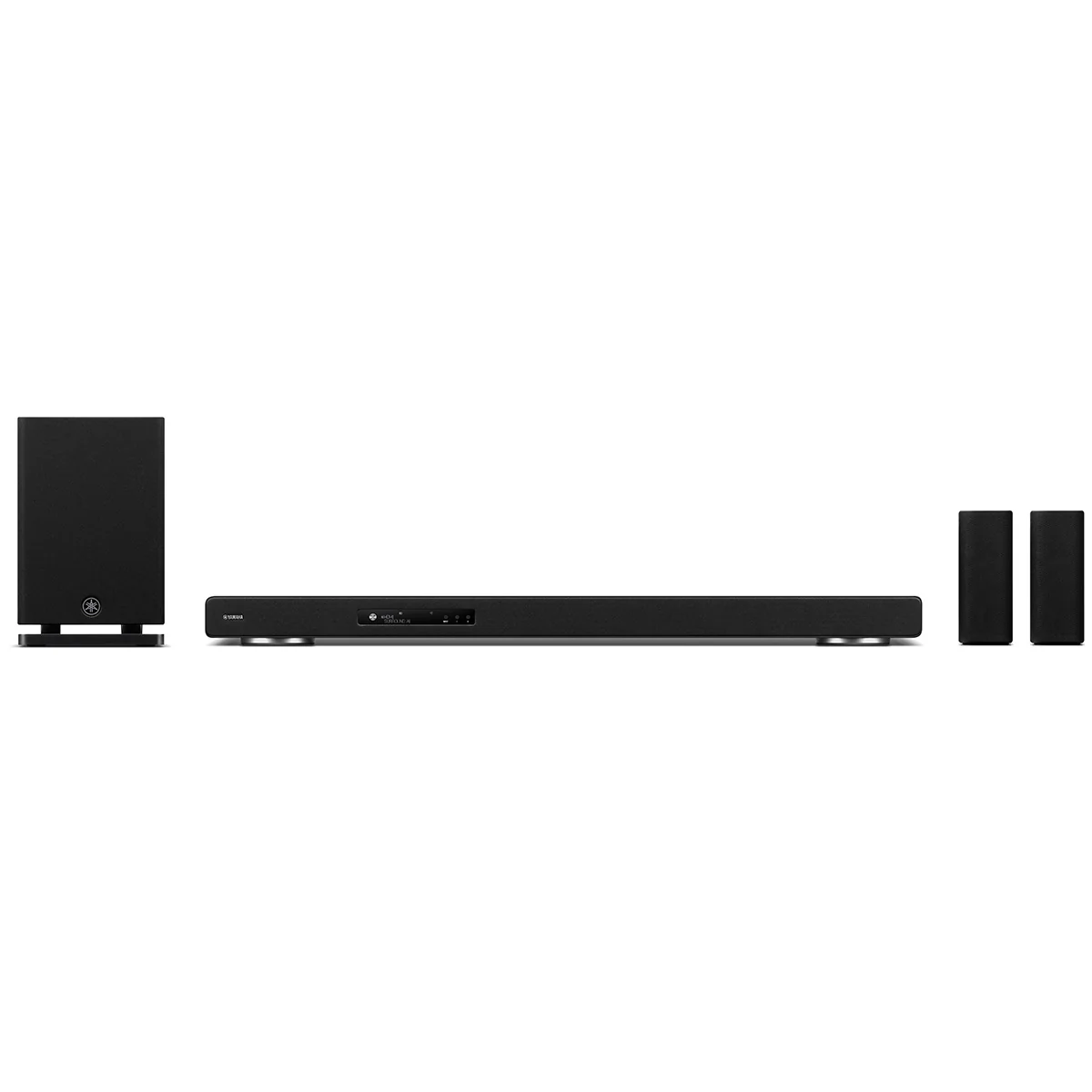
The main bar stretches just under four feet wide and about three inches tall, making it a good visual fit beneath a 55- to 75-inch television. It has a dense, metal-reinforced chassis with a smooth fabric wrap and minimal visual clutter. Everything about it feels solid, from the damped circular feet underneath that give it excellent stability to the smooth, subtle display tucked behind the grille. It is clearly engineered for both acoustic performance and a premium presence in the room.

The front of the bar houses the left, center, and right channels, each using Yamaha’s custom 4.4 by 2 inch oval full-range drivers paired with 1 inch dome tweeters to deliver clear, focused dialogue and well-balanced mids. Above them sits an array of twelve 1.1 inch beam drivers, six on each end of the bar, that fire sound upward to create the height and width effects that make this system so immersive. This approach builds on the same digital sound projection technology Yamaha pioneered with its early YSP soundbars, which use precise DSP timing to steer beams of sound and reflect them off your walls and ceiling.
This system also comes with a wireless subwoofer that feels compact but decently well built. It uses a 6.75-inch driver and Yamaha’s newly developed Symmetrical Flare Port to reduce turbulence and deliver deeper, smoother bass. You can tell it has been designed to complement the bar rather than overpower it, offering punch and precision instead of boom. It sits comfortably beside a media console or in a corner, and because it connects wirelessly, you can place it almost anywhere. We recommend watching our Audio Advice subwoofer placement video to help find the ideal spot in your room to really get the most out of it.


But what’s really cool is the True X Speaker 3A surrounds. Each one is a small cylindrical speaker with dual full-range drivers and passive radiators. They can run off their internal rechargeable batteries for up to twelve hours or stay powered while sitting on their included charging pads. Where it gets fun is the fact that you can press one button on them and switch into bluetooth mode and use them as individual portable speakers or pair them together for stereo sound. You can even take them outside by the pool since they’re IP67 rated so you don’t have to worry about getting them a little wet. So, you essentially have wireless rechargeable surround speakers for when you’re using your soundbar system, and then two really high quality portable bluetooth speakers that you can take with you on the go when you need them. It’s one of the most versatile designs we have seen in any wireless surround system, and it adds a layer of practicality that helps justify the cost.
Now, we will say that some other soundbars like the JBL 1300X have wireless rechargeable surround speakers that let you use them without the soundbar, but those aren’t IP67 rated, so you need to be careful where you take them. These Yamaha surrounds feel way more robust and to us, sound a lot better.
However, if we had to nitpick here, we’ll say that the charging pads for these surround speakers are convenient but not perfect. They come with detachable USB-A to USB-C cables that are only about two feet long, which can be frustrating if you don’t have an outlet nearby. The good news is that because the cables are removable, you can easily swap them for longer ones if needed. Yamaha doesn’t include the charging bricks in the box, and at this price point, we would have loved to see USB-C to USB-C cables and matching power adapters included. Still, if you want a completely wireless look, you can simply charge the surrounds occasionally in a different location and remove the pads altogether. In our testing, we averaged about two to three days of use on a full charge and had no dropouts during testing.


Features & Setup
When it comes to the features and tech packed inside, Yamaha shows it’s deep roots in both AV receivers and modern streaming systems. The bar supports Dolby Atmos, DTS:X, and Auro-3D. At the heart of it all is Yamaha’s SURROUND:AI processing engine, powered by the same 64-bit chip found in their flagship AVENTAGE receivers. This system analyzes incoming content in real time, adjusting balance, dynamics, and spatial cues depending on the type of scene. A quiet dialogue moment is treated differently from a car chase, and those transitions happen seamlessly.
The twelve beam drivers on top of the bar are where the magic happens. Rather than simply bouncing generic sound upward, Yamaha precisely times each one to direct energy toward your walls and ceiling, creating reflections that make sound appear to come from specific points around you. When the room conditions are right, the sense of immersion is remarkable. One thing worth noting is that the True X Surround 90A doesn’t include any kind of automatic room calibration or microphone-based setup like you’ll find on some higher-end receivers or soundbars. Yamaha’s AV receivers use a system called YPAO (Yamaha Parametric Room Acoustic Optimizer), which analyzes your room with a microphone and automatically adjusts EQ and delays for optimal sound. That feature isn’t built into the 90A, though. Instead, you get manual controls for adjusting beam angle, focal length, and ceiling height within the on-screen menu. These let you fine-tune how the sound reflects and fills your space, but it’s up to you to make those tweaks by ear. The good news is that Yamaha’s beam-steering tech is already very refined, so even without automatic calibration, it sounds balanced and immersive right out of the box. Still, it’s something to keep in mind if you prefer a system that handles all the measuring and tuning for you.
Connectivity is simple but well thought out. There is one HDMI input and one HDMI eARC output for your television, as well as an optical input if you are using an older display. The HDMI input allows you to connect a Blu-ray player, streaming box, or console directly, which is rare nowadays in soundbars so we we excited to see it here. Although, we will note that it doesn’t support HDMI 2.1 gaming features like 4K120 or variable refresh rate. But most users will simply use eARC to send audio from their TV and use their TV remote, and that works flawlessly once CEC is enabled through the on-screen setup menu. We also would have loved to see a subwoofer output for those who might want to add an external sub, but the included wireless subwoofer is solid enough that most users probably won’t feel the need to upgrade.

Streaming is where Yamaha’s ecosystem really shines. The 90A supports Wi-Fi, AirPlay 2, Spotify Connect, and TIDAL Connect, along with Bluetooth for quick pairing. The MusicCast app gives you access to Amazon Music, Qobuz, Pandora, SiriusXM, and more, and lets you link the bar to other Yamaha wireless speakers throughout your home. The app is great for streaming and multiroom playback, but for setup, we found it best to use the on-screen display, which appears on your TV when the soundbar is connected via HDMI. It’s fairly straightforward and includes most of what you need to get started, although some of the menu language could be a little clearer. Here, you’ll pair the subwoofer and surrounds through the “registration” section, and you’ll also want to turn on the True X Ready setting, which allows the surrounds to power on automatically each time the soundbar starts up.
There’s also a small display built directly into the front of the bar that shows useful real-time information such as input selection, volume level, and sound mode. It’s bright, easy to read, and a thoughtful detail that makes everyday use much simpler.
You can also switch between DTS and Dolby decoding in the menu, and we recommend trying both to see which you prefer. For Dolby Atmos content, Dolby Surround mode provided a slightly more cohesive soundstage in our testing. The app also provides some simple EQ controls, like bass and treble sliders and a bass extension option, but we would have liked to see more flexibility here. Still, between the app, the remote, the bar’s small front display, and the on screen display, it’s easy to monitor connections and make adjustments.

Performance
Clearly, there is a lot of technology packed inside this system and it all pays off once you start listening. After setup and a bit of fine-tuning, the Yamaha True X Surround 90A delivers a soundstage that feels far larger than its footprint. Dolby Atmos effects soar overhead, dialogue stays locked to the center of the screen, and effects move seamlessly across the room. With a flat ceiling around eight to ten feet high, the twelve beam drivers produce a pretty believable sense of height for a Dolby Atmos soundbar that fills the space above you and to your sides.
Dialogue clarity is excellent, especially when using the Clear Voice feature. The midrange sounds balanced and natural, and treble detail adds sparkle without becoming fatiguing when properly adjusted. The subwoofer’s bass output is impressive for its size. It doesn’t shake the walls like a large separate sub, but it integrates beautifully with the main bar. Once you find the right placement, it provides clean, punchy low-end extension that brings energy and realism to movies and music alike.
Finally, the wireless surrounds elevate the entire experience. They deliver real rear-channel separation, something most soundbars only simulate, and they stayed perfectly in sync with no lag or dropouts during testing. When combined with the beam-steered height effects, the result is a cohesive 360-degree sound field that feels immersive and cinematic. Watching movies like Top Gun Maverick or Dune showcases the system’s dynamic range, scale, and ability to create a believable sense of motion all around you.
Yamaha includes several listening modes designed to tailor the experience for both music and movies. Surround:AI uses Yamaha’s processing engine to analyze each scene or song in real time, automatically adjusting elements like dialogue, effects, and ambience for a more natural, cinematic presentation. 3D Music mode expands the stereo image vertically and horizontally, creating an immersive soundstage that feels like you’re sitting in a live performance space. Straight mode preserves the original signal path for purists who prefer an unaltered two-channel presentation, while Stereo offers a more traditional left-right layout that still takes advantage of Yamaha’s refined tuning. Finally, All mode plays audio through every speaker in the system for maximum room-filling sound, great for parties or casual listening.
Music performance is also strong. Dolby Atmos Music tracks sound spacious and enveloping, while stereo tracks benefit from Yamaha’s 3D Music and Surround:AI modes, which open up the soundstage without losing clarity. Straight mode offers the most direct, two-channel presentation for those who prefer it. High-resolution streaming through MusicCast worked flawlessly, delivering full detail and depth.
Final Thoughts
The Yamaha True X Surround 90A represents the best of what Yamaha can do in a modern home theater sound system. It brings together the company’s decades of acoustic engineering, their experience in AV receiver design, and their innovation in wireless audio into one cohesive package. The ability to take the surround speakers with you and use them as portable Bluetooth speakers is an excellent bonus, adding real-world value beyond home theater use.
If you’re deciding between the True X Bar 90A and the True X Surround 90A, it really comes down to how immersive you want your setup to be. The bar alone sounds powerful and refined, but to us, the surrounds add a lot to the experience and are absolutely worth it. They transform the system into a full-fledged theater setup with true rear-channel separation and a greater sense of space.
In the end, the True X Surround 90A is one of the most complete, flexible, and well-engineered Dolby Atmos systems available today. It offers the clarity, balance, and realism of Yamaha’s best soundbars while introducing new versatility that makes it stand out. With proper setup and placement, it delivers cinematic sound that fills your room and feels unmistakably Yamaha.
We’re Here to Help!
If you have further questions, contact our experts via chat, phone, or email. Or simply visit one of our world-class showrooms to experience speakers, projectors, TVs, and everything in between for yourself before you make a purchase!
If you’re planning your home theater or media room, check out our Home Theater Design page, where we have everything Home Theater related, including our FREE Home Theater Design Tool.
When you buy from Audio Advice, you’re buying from a trusted seller since 1978. We offer Free Shipping, Lifetime Expert Support, and our Price Guarantee. We look forward to serving you!
Original: $3,499.95
-70%$3,499.95
$1,049.98Product Information
Product Information
Shipping & Returns
Shipping & Returns
Description
The new True X Surround 90A soundbar from Yamaha feels like a full-circle moment for the brand, bringing their long history of innovation in home theater into a completely modern system designed for today’s Dolby Atmos world. It’s available both as a standalone soundbar with subwoofer, called the True X Bar 90A, or as the full True X Surround 90A package that adds Yamaha’s wireless rechargeable surround speakers for a completely immersive setup. Let’s dive in and see if Yamaha’s new soundbar system can compete in a category filled with some already pretty awesome products.
Design & Build Quality
Before getting into the physical design, it’s worth remembering just how deep Yamaha’s roots go in this category. In 1985, Yamaha released the DSP-1, the world’s first standalone digital sound field processor for home use. It didn’t decode Dolby Surround like later systems, but instead, Yamaha’s engineers captured impulse responses from real concert halls and theaters and used digital signal processing to recreate those environments in your living room. That groundbreaking approach laid the foundation for what became Yamaha’s signature Digital Sound Field Processing (DSP), which still appears in their receivers and processors today.
Nearly two decades later, Yamaha reshaped home audio again with the YSP-1, introduced in 2004 as the world’s first powered soundbar. It wasn’t a simple stereo speaker. It was a fully self-contained system with 42 drivers, each individually amplified and DSP-controlled to beam sound around the room and simulate true surround effects. This Digital Sound Projector technology became the blueprint for nearly every modern soundbar that followed.
Fast forward to today, and the True X Surround 90A feels like a culmination of that legacy. It’s an updated, next-generation version of Yamaha’s beam-steering philosophy, now enhanced with wireless flexibility and Dolby Atmos capability.
The main bar stretches just under four feet wide and about three inches tall, making it a good visual fit beneath a 55- to 75-inch television. It has a dense, metal-reinforced chassis with a smooth fabric wrap and minimal visual clutter. Everything about it feels solid, from the damped circular feet underneath that give it excellent stability to the smooth, subtle display tucked behind the grille. It is clearly engineered for both acoustic performance and a premium presence in the room.
The front of the bar houses the left, center, and right channels, each using Yamaha’s custom 4.4 by 2 inch oval full-range drivers paired with 1 inch dome tweeters to deliver clear, focused dialogue and well-balanced mids. Above them sits an array of twelve 1.1 inch beam drivers, six on each end of the bar, that fire sound upward to create the height and width effects that make this system so immersive. This approach builds on the same digital sound projection technology Yamaha pioneered with its early YSP soundbars, which use precise DSP timing to steer beams of sound and reflect them off your walls and ceiling.
This system also comes with a wireless subwoofer that feels compact but decently well built. It uses a 6.75-inch driver and Yamaha’s newly developed Symmetrical Flare Port to reduce turbulence and deliver deeper, smoother bass. You can tell it has been designed to complement the bar rather than overpower it, offering punch and precision instead of boom. It sits comfortably beside a media console or in a corner, and because it connects wirelessly, you can place it almost anywhere. We recommend watching our Audio Advice subwoofer placement video to help find the ideal spot in your room to really get the most out of it.
But what’s really cool is the True X Speaker 3A surrounds. Each one is a small cylindrical speaker with dual full-range drivers and passive radiators. They can run off their internal rechargeable batteries for up to twelve hours or stay powered while sitting on their included charging pads. Where it gets fun is the fact that you can press one button on them and switch into bluetooth mode and use them as individual portable speakers or pair them together for stereo sound. You can even take them outside by the pool since they’re IP67 rated so you don’t have to worry about getting them a little wet. So, you essentially have wireless rechargeable surround speakers for when you’re using your soundbar system, and then two really high quality portable bluetooth speakers that you can take with you on the go when you need them. It’s one of the most versatile designs we have seen in any wireless surround system, and it adds a layer of practicality that helps justify the cost.
Now, we will say that some other soundbars like the JBL 1300X have wireless rechargeable surround speakers that let you use them without the soundbar, but those aren’t IP67 rated, so you need to be careful where you take them. These Yamaha surrounds feel way more robust and to us, sound a lot better.
However, if we had to nitpick here, we’ll say that the charging pads for these surround speakers are convenient but not perfect. They come with detachable USB-A to USB-C cables that are only about two feet long, which can be frustrating if you don’t have an outlet nearby. The good news is that because the cables are removable, you can easily swap them for longer ones if needed. Yamaha doesn’t include the charging bricks in the box, and at this price point, we would have loved to see USB-C to USB-C cables and matching power adapters included. Still, if you want a completely wireless look, you can simply charge the surrounds occasionally in a different location and remove the pads altogether. In our testing, we averaged about two to three days of use on a full charge and had no dropouts during testing.
Features & Setup
When it comes to the features and tech packed inside, Yamaha shows it’s deep roots in both AV receivers and modern streaming systems. The bar supports Dolby Atmos, DTS:X, and Auro-3D. At the heart of it all is Yamaha’s SURROUND:AI processing engine, powered by the same 64-bit chip found in their flagship AVENTAGE receivers. This system analyzes incoming content in real time, adjusting balance, dynamics, and spatial cues depending on the type of scene. A quiet dialogue moment is treated differently from a car chase, and those transitions happen seamlessly.
The twelve beam drivers on top of the bar are where the magic happens. Rather than simply bouncing generic sound upward, Yamaha precisely times each one to direct energy toward your walls and ceiling, creating reflections that make sound appear to come from specific points around you. When the room conditions are right, the sense of immersion is remarkable. One thing worth noting is that the True X Surround 90A doesn’t include any kind of automatic room calibration or microphone-based setup like you’ll find on some higher-end receivers or soundbars. Yamaha’s AV receivers use a system called YPAO (Yamaha Parametric Room Acoustic Optimizer), which analyzes your room with a microphone and automatically adjusts EQ and delays for optimal sound. That feature isn’t built into the 90A, though. Instead, you get manual controls for adjusting beam angle, focal length, and ceiling height within the on-screen menu. These let you fine-tune how the sound reflects and fills your space, but it’s up to you to make those tweaks by ear. The good news is that Yamaha’s beam-steering tech is already very refined, so even without automatic calibration, it sounds balanced and immersive right out of the box. Still, it’s something to keep in mind if you prefer a system that handles all the measuring and tuning for you.
Connectivity is simple but well thought out. There is one HDMI input and one HDMI eARC output for your television, as well as an optical input if you are using an older display. The HDMI input allows you to connect a Blu-ray player, streaming box, or console directly, which is rare nowadays in soundbars so we we excited to see it here. Although, we will note that it doesn’t support HDMI 2.1 gaming features like 4K120 or variable refresh rate. But most users will simply use eARC to send audio from their TV and use their TV remote, and that works flawlessly once CEC is enabled through the on-screen setup menu. We also would have loved to see a subwoofer output for those who might want to add an external sub, but the included wireless subwoofer is solid enough that most users probably won’t feel the need to upgrade.
Streaming is where Yamaha’s ecosystem really shines. The 90A supports Wi-Fi, AirPlay 2, Spotify Connect, and TIDAL Connect, along with Bluetooth for quick pairing. The MusicCast app gives you access to Amazon Music, Qobuz, Pandora, SiriusXM, and more, and lets you link the bar to other Yamaha wireless speakers throughout your home. The app is great for streaming and multiroom playback, but for setup, we found it best to use the on-screen display, which appears on your TV when the soundbar is connected via HDMI. It’s fairly straightforward and includes most of what you need to get started, although some of the menu language could be a little clearer. Here, you’ll pair the subwoofer and surrounds through the “registration” section, and you’ll also want to turn on the True X Ready setting, which allows the surrounds to power on automatically each time the soundbar starts up.
There’s also a small display built directly into the front of the bar that shows useful real-time information such as input selection, volume level, and sound mode. It’s bright, easy to read, and a thoughtful detail that makes everyday use much simpler.
You can also switch between DTS and Dolby decoding in the menu, and we recommend trying both to see which you prefer. For Dolby Atmos content, Dolby Surround mode provided a slightly more cohesive soundstage in our testing. The app also provides some simple EQ controls, like bass and treble sliders and a bass extension option, but we would have liked to see more flexibility here. Still, between the app, the remote, the bar’s small front display, and the on screen display, it’s easy to monitor connections and make adjustments.
Performance
Clearly, there is a lot of technology packed inside this system and it all pays off once you start listening. After setup and a bit of fine-tuning, the Yamaha True X Surround 90A delivers a soundstage that feels far larger than its footprint. Dolby Atmos effects soar overhead, dialogue stays locked to the center of the screen, and effects move seamlessly across the room. With a flat ceiling around eight to ten feet high, the twelve beam drivers produce a pretty believable sense of height for a Dolby Atmos soundbar that fills the space above you and to your sides.
Dialogue clarity is excellent, especially when using the Clear Voice feature. The midrange sounds balanced and natural, and treble detail adds sparkle without becoming fatiguing when properly adjusted. The subwoofer’s bass output is impressive for its size. It doesn’t shake the walls like a large separate sub, but it integrates beautifully with the main bar. Once you find the right placement, it provides clean, punchy low-end extension that brings energy and realism to movies and music alike.
Finally, the wireless surrounds elevate the entire experience. They deliver real rear-channel separation, something most soundbars only simulate, and they stayed perfectly in sync with no lag or dropouts during testing. When combined with the beam-steered height effects, the result is a cohesive 360-degree sound field that feels immersive and cinematic. Watching movies like Top Gun Maverick or Dune showcases the system’s dynamic range, scale, and ability to create a believable sense of motion all around you.
Yamaha includes several listening modes designed to tailor the experience for both music and movies. Surround:AI uses Yamaha’s processing engine to analyze each scene or song in real time, automatically adjusting elements like dialogue, effects, and ambience for a more natural, cinematic presentation. 3D Music mode expands the stereo image vertically and horizontally, creating an immersive soundstage that feels like you’re sitting in a live performance space. Straight mode preserves the original signal path for purists who prefer an unaltered two-channel presentation, while Stereo offers a more traditional left-right layout that still takes advantage of Yamaha’s refined tuning. Finally, All mode plays audio through every speaker in the system for maximum room-filling sound, great for parties or casual listening.
Music performance is also strong. Dolby Atmos Music tracks sound spacious and enveloping, while stereo tracks benefit from Yamaha’s 3D Music and Surround:AI modes, which open up the soundstage without losing clarity. Straight mode offers the most direct, two-channel presentation for those who prefer it. High-resolution streaming through MusicCast worked flawlessly, delivering full detail and depth.
Final Thoughts
The Yamaha True X Surround 90A represents the best of what Yamaha can do in a modern home theater sound system. It brings together the company’s decades of acoustic engineering, their experience in AV receiver design, and their innovation in wireless audio into one cohesive package. The ability to take the surround speakers with you and use them as portable Bluetooth speakers is an excellent bonus, adding real-world value beyond home theater use.
If you’re deciding between the True X Bar 90A and the True X Surround 90A, it really comes down to how immersive you want your setup to be. The bar alone sounds powerful and refined, but to us, the surrounds add a lot to the experience and are absolutely worth it. They transform the system into a full-fledged theater setup with true rear-channel separation and a greater sense of space.
In the end, the True X Surround 90A is one of the most complete, flexible, and well-engineered Dolby Atmos systems available today. It offers the clarity, balance, and realism of Yamaha’s best soundbars while introducing new versatility that makes it stand out. With proper setup and placement, it delivers cinematic sound that fills your room and feels unmistakably Yamaha.
We’re Here to Help!
If you have further questions, contact our experts via chat, phone, or email. Or simply visit one of our world-class showrooms to experience speakers, projectors, TVs, and everything in between for yourself before you make a purchase!
If you’re planning your home theater or media room, check out our Home Theater Design page, where we have everything Home Theater related, including our FREE Home Theater Design Tool.
When you buy from Audio Advice, you’re buying from a trusted seller since 1978. We offer Free Shipping, Lifetime Expert Support, and our Price Guarantee. We look forward to serving you!